
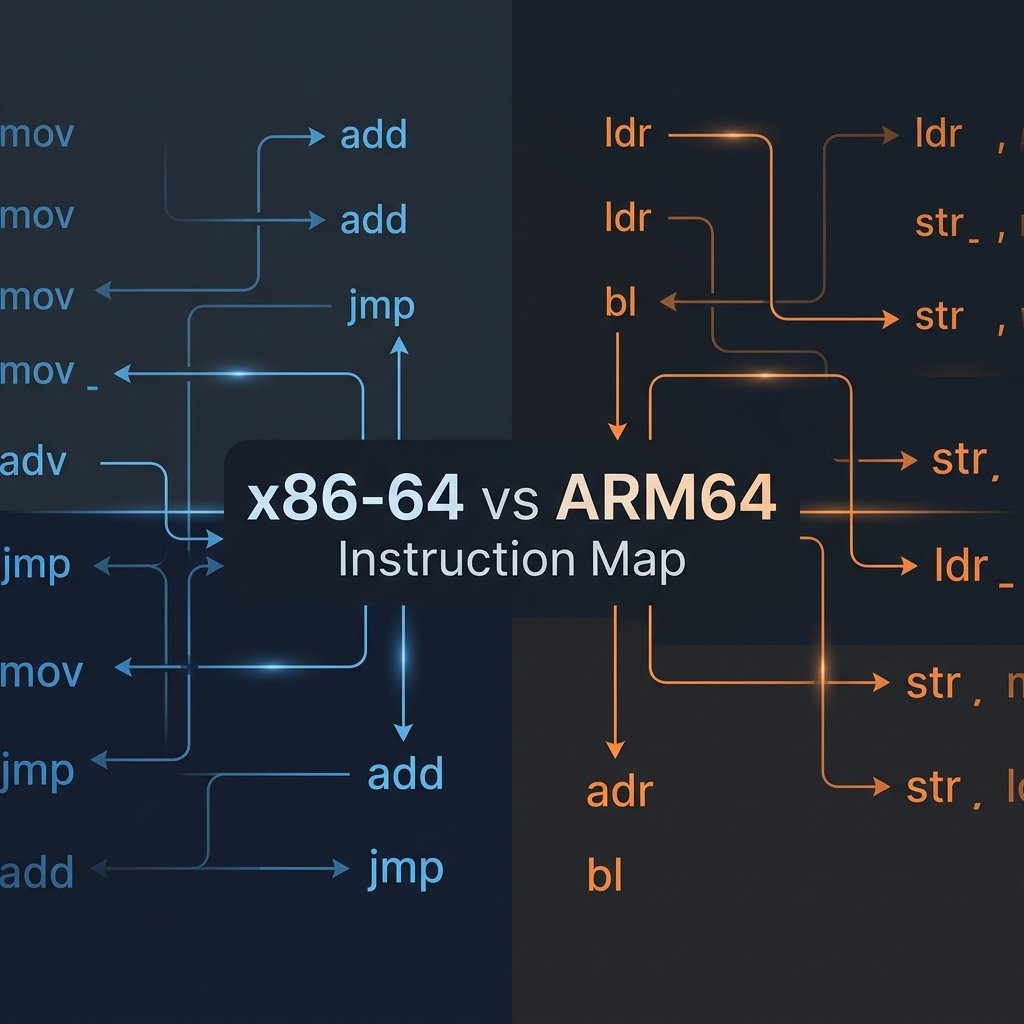
This x86-64 vs ARM64 instruction map shows the most common assembly instructions on both dominant 64-bit architectures side by side. Use it as a translation table when reading disassembly, porting code, or studying compiler output across platforms. Each row shows the equivalent operation with key differences noted.
For hands-on tutorials, see our Assembly Syscall Deep Dive (Linux/macOS, both architectures) and Calling Conventions Demystified. The authoritative references are the Intel Software Developer’s Manual and the ARM Architecture Reference Manual.
Data Movement in This x86-64 vs ARM64 Instruction Map
The biggest difference: ARM64 is a load-store architecture — arithmetic instructions cannot access memory directly. x86-64 allows memory operands in most instructions. This x86-64 ARM64 instruction map starts with data movement because it is the most frequent operation category.
| Operation | x86-64 | ARM64 | Notes |
|---|---|---|---|
| Register → Register | mov rax, rbx | mov x0, x1 | |
| Immediate → Register | mov rax, 42 | mov x0, #42 | ARM64: 16-bit per movz/movk |
| Load from memory | mov rax, [rbp-8] | ldr x0, [x29, #-8] | ARM64: separate load instruction |
| Store to memory | mov [rbp-8], rax | str x0, [x29, #-8] | ARM64: separate store instruction |
| Load effective address | lea rax, [rip+label] | adr x0, label | PC-relative; ARM64 also has adrp |
| Zero-extend byte load | movzx eax, byte [rbp-1] | ldrb w0, [x29, #-1] | |
| Sign-extend byte load | movsx rax, byte [rbp-1] | ldrsb x0, [x29, #-1] | |
| Push to stack | push rax | str x0, [sp, #-16]! | ARM64 often uses stp for register pairs |
| Pop from stack | pop rax | ldr x0, [sp], #16 | ARM64 often uses ldp for register pairs |
| Conditional move | cmovz rax, rbx | csel x0, x1, x0, eq | ARM64 csel selects between two registers |
| Load pair | — (no equivalent) | ldp x0, x1, [sp] | ARM64 can load/store two registers at once |
Arithmetic
Arithmetic instructions are largely analogous, but x86-64 uses two-operand form (destination is also a source) while ARM64 uses three-operand form (separate destination).
| Operation | x86-64 | ARM64 | Notes |
|---|---|---|---|
| Add | add rax, rbx | add x0, x0, x1 | ARM64: 3-operand (dst, src1, src2) |
| Add with carry | adc rax, rbx | adc x0, x0, x1 | |
| Subtract | sub rax, rbx | sub x0, x0, x1 | |
| Subtract with borrow | sbb rax, rbx | sbc x0, x0, x1 | |
| Multiply (low result) | imul rax, rbx | mul x0, x1, x2 | x86-64 two-operand form; result truncated to register width |
| Multiply high | mul rbx → RDX:RAX | umulh x0, x1, x2 | x86-64: unsigned (mul) and signed (imul) one-operand forms; ARM64: separate smulh/umulh |
| Multiply-accumulate | — (no single instruction) | madd x0, x1, x2, x3 | x0 = x1 × x2 + x3 |
| Divide (signed) | idiv rbx | sdiv x0, x1, x2 | x86-64: divides RDX:RAX, result in RAX |
| Divide (unsigned) | div rbx | udiv x0, x1, x2 | x86-64: remainder in RDX |
| Negate | neg rax | neg x0, x1 | |
| Increment | inc rax | add x0, x0, #1 | ARM64 has no dedicated inc/dec |
| Decrement | dec rax | sub x0, x0, #1 |
Logic & Bitwise Operations
Logical operations map almost directly. ARM64 adds bic (bit clear = AND NOT) and eon (exclusive OR NOT) as single instructions.
| Operation | x86-64 | ARM64 | Notes |
|---|---|---|---|
| Bitwise AND | and rax, rbx | and x0, x0, x1 | |
| Bitwise OR | or rax, rbx | orr x0, x0, x1 | ARM64 mnemonic is orr |
| Bitwise XOR | xor rax, rbx | eor x0, x0, x1 | ARM64 mnemonic is eor |
| Bitwise NOT | not rax | mvn x0, x1 | ARM64: MoVe Not |
| Bit clear (AND NOT) | andn rax, rbx, rcx (BMI1) | bic x0, x1, x2 | x86-64: rax = (~rbx) AND rcx; ARM64: x0 = x1 AND (~x2) — NOT applied to opposite source |
| Logical shift left | shl rax, cl | lsl x0, x1, x2 | |
| Logical shift right | shr rax, cl | lsr x0, x1, x2 | |
| Arithmetic shift right | sar rax, cl | asr x0, x1, x2 | Preserves sign bit |
| Rotate right | ror rax, cl | ror x0, x1, x2 | |
| Count leading zeros | lzcnt rax, rbx | clz x0, x1 | x86-64 requires LZCNT extension |
| Test bit + branch | bt rax, 5 + jc label | tbnz x0, #5, label | x86-64: two instructions; ARM64: fused test-and-branch |
Comparison & Branching
Both architectures use condition flags (RFLAGS / PSTATE). The conditional branch mnemonics differ but map to the same conditions. ARM64’s cbz/cbnz combine compare-with-zero and branch into a single instruction.
| Operation | x86-64 | ARM64 | Notes |
|---|---|---|---|
| Compare | cmp rax, rbx | cmp x0, x1 | Sets flags (SUB without storing) |
| Test (AND without storing) | test rax, rbx | tst x0, x1 | |
| Branch if equal | je label | b.eq label | |
| Branch if not equal | jne label | b.ne label | |
| Branch if less (signed) | jl label | b.lt label | |
| Branch if greater (signed) | jg label | b.gt label | |
| Branch if ≤ (signed) | jle label | b.le label | |
| Branch if ≥ (signed) | jge label | b.ge label | |
| Branch if below (unsigned) | jb label | b.lo label | Carry flag / unsigned |
| Branch if above (unsigned) | ja label | b.hi label | |
| Unconditional jump | jmp label | b label | |
| Branch if zero | test rax, rax + je label | cbz x0, label | ARM64 fuses test+branch |
| Branch if nonzero | test rax, rax + jne label | cbnz x0, label | |
| Call function | call func | bl func | ARM64: return address in X30 (LR) |
| Return | ret | ret | x86-64 pops from stack; ARM64 uses X30 |
System Interface
System calls use different instructions and register conventions on each architecture. The syscall number register and argument registers differ — refer to the Calling Conventions Cheat Sheet for the full register mapping.
| Operation | x86-64 | ARM64 | Notes |
|---|---|---|---|
| System call | syscall | svc #0 | Syscall # in RAX vs X8 |
| Breakpoint | int3 | brk #0 | Used by debuggers |
| No operation | nop | nop | |
| Memory barrier | mfence | dmb sy | ARM64 has finer-grained barriers |
| Halt / Yield | pause | yield | Spin-loop hint for HyperThreading / SMT |
Key Architectural Differences
Understanding these fundamental differences helps when reading this x86-64 ARM64 instruction map and translating between architectures:
Fixed vs. Variable-Length Instructions: ARM64 uses fixed 32-bit (4-byte) instructions, making disassembly trivial — every instruction starts at a 4-byte boundary. x86-64 instructions vary from 1 to 15 bytes, requiring sequential decoding from a known starting point.
Load-Store Architecture: ARM64 arithmetic operates only on registers. To add a value from memory, you must first ldr it into a register, then add. x86-64 can embed memory operands directly: add rax, [rbp-8].
Link Register vs. Stack Return: On ARM64, bl (branch with link) stores the return address in X30 (LR), and ret branches to X30. On x86-64, call pushes the return address onto the stack, and ret pops it. This means ARM64 leaf functions don’t need to save LR or set up a stack frame, though they may still use stack space for local variables.
Condition Codes: Both architectures set flags after certain operations, but ARM64 requires explicit flag-setting variants (adds, subs) for arithmetic — plain add/sub do not set flags. On x86-64, most arithmetic instructions always update RFLAGS.
PC-Relative Addressing: ARM64’s adrp/add pair can reach any address within ±4 GB of the current PC, while x86-64’s RIP-relative addressing reaches ±2 GB. Both are used for position-independent code.
How to Use This x86-64 ARM64 Instruction Map
This x86-64 ARM64 instruction map is designed as a quick-lookup reference. When you encounter an unfamiliar instruction in disassembly output, find its row in the relevant table to see the equivalent on the other architecture. For deeper context on how these instructions interact with calling conventions and stack frames, see the related resources below.
Keep in mind that some mappings are not 1:1 — x86-64’s CISC heritage means a single instruction (like push) may require two ARM64 instructions (a subtract and a store). Conversely, ARM64 offers fused operations like madd (multiply-accumulate) and cbz (compare-and-branch) that require multiple x86-64 instructions.
Related Resources
Deep dives: Assembly Hello World: Cross-Platform Syscall Tutorial | Calling Conventions Demystified | Stack Frames & Function Prologues
Also see: Calling Conventions Cheat Sheet | Assembly Directives Reference | Systems Programming Glossary
Official references: Intel SDM | ARM Architecture Reference Manual